CAS in Legal Data Science

Interested?
If you are interested in the CAS in legal data science and would like to receive more information, enter your details here: CAS-NEWS
Table of contents
Do you want to learn how to...
- Understand – and critically assess – statistical analyses in legal contexts, such as court cases and expert reports?
- Use basic Python tools to automate repetitive legal tasks?
- Apply basic statistical and machine learning tools to obtain insights from legal data?
- Use large language models for legal tasks responsibly?
Overview
The CAS in Legal Data Science is a practical training program for legal professionals who want to analyze cases, contracts, and regulatory materials at scale. Participants learn Python fundamentals and the end-to-end pipeline: data acquisition, preprocessing, quantitative analysis, visualization, and reporting. The focus is on usable skills - building small tools, validating results, and communicating findings to legal audiences - grounded in legal requirements (data protection, confidentiality, governance) and professional ethics.
Taught entirely in English, the CAS follows a blended learning approach combining in-person sessions and podcasts.
The program consists of five modules, including a Capstone Project, and is completed over two semesters starting each September. Participants benefit from continuous academic support and a flexible study structure, with mandatory in-person attendance for a small number of sessions (taking place on Friday afternoons and Saturday mornings).
Upon successful completion, participants receive a Certificate of Advanced Studies in Legal Data Science (CAS UZH, 12 ECTS).
Key Facts
Teaching mode
The program is designed to accommodate the diverse professional and personal backgrounds of its participants. Courses will take place on 10 half-days over a total of 5 weekends on Friday afternoons and Saturday mornings. The course consists of 20 lectures of 90 minutes each, spread across five modules, corresponding to approximately 30 hours of direct contact time.
The course starts in September and ends in June (including exam days).
Course dates are set taking into account public holidays and school holidays in the city of Zurich.
CAS lecture dates 2026/2027*
Modules 1 & 2
Friday, 25 September 2026, 13:30 – 17:00
Saturday, 26 September 2026, 9:00 – 12:30
Friday, 23 October 2026, 13:30 – 17:00
Saturday, 24 October 2026, 9:00 – 12:30
Friday, 20 November 2026, 13:30 – 17:00
Saturday, 21 November 2026, 9:00 – 12:30
Module 3 & 4
Friday, 5 March 2027, 13:30 – 17:00
Saturday, 6 March 2027, 9:00 – 12:30
Friday, 9 April 2027, 13:30 – 17:00
Saturday, 10 April 2027, 9:00 – 12:30
Module 5
April / May 2027
Capstone submission deadline: Sunday, 6 June 27
Exam dates
Module 1& 2: Friday, 29 January 2027, (13:30 – 16:00)
Module 3 & 4: Friday, 25 June 2027, (13:30 – 16:00)
Graduation ceremony
9 September 2027 (18:00)
Information event
tbd.
Join this Info session in person or online via Zoom.
In-person location:
Center for Legal Data Science (CLDS), University of Zurich
Pestalozzistrasse 24
8032 Zürich
Application deadline, 16 August 2026
Application deadline Early Bird, 14 June 2026
*Subject to change.
Teaching Language
The entire course is conducted in English.
Location
The in-person lectures take place at the Centre for Continuing Education at the University of Zurich.
University of Zurich
Centre for Continuing Education
Schaffhauserstrasse 228
CH-8057 Zurich
Telephone +41 44 635 22 55
zwbinfo@wb.uzh.ch
The Centre for Continuing Education is located in Zurich-Oerlikon and can be reached from Zurich city centre in about 10 minutes by public transport. Paid parking for cars (via digitalparking or TWINT) and bicycle spaces are available. From Zurich main station or Oerlikon, take tram 10 or 51 to Hirschwiesenstrasse or Berninaplatz.
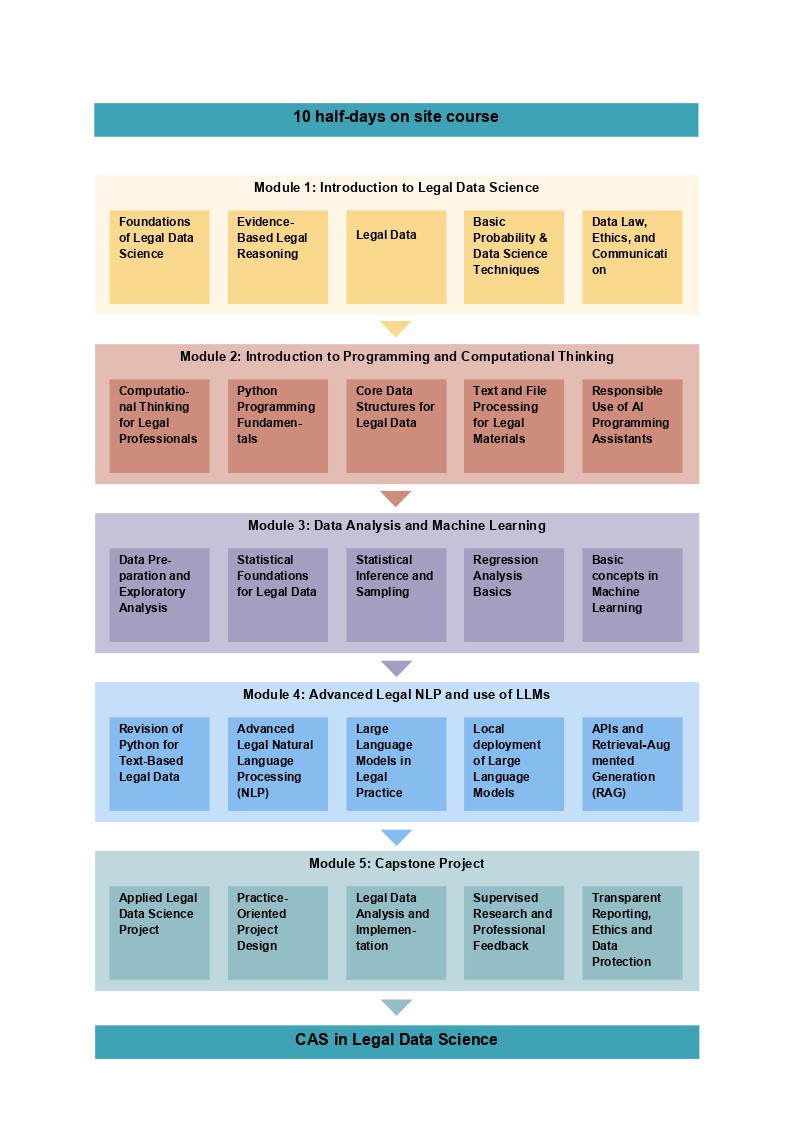
Modules
Module 1: Introduction to Legal Data Science (3 ECTS, Fall Semester)
Module 1 introduces participants to Legal Data Science and provides the conceptual foundations for the entire CAS. Participants learn to understand, assess, and responsibly use data-driven and statistics-based legal reasoning. Wherever possible, discussions are anchored in practical legal cases and real-world scenarios.
Core themes
- Introduction to Legal Data Science: What Legal Data Science is, key use cases in legal practice, and how it relates to neighboring fields (e.g., empirical legal studies, statistics, and computer science).
- Evidence-based legal reasoning: How quantitative evidence enters legal argumentation.
- Legal data: Legal data sources, data quality, and typical pitfalls in collecting and interpreting legal information.
- Basic probability: introduction to probability concepts and their application to legal data science.
- Techniques in Legal Data Science: An overview of common statistical approaches (descriptive statistics and basic inference) and what they can – and cannot – deliver in legal contexts.
- Data law, data ethics, and communication: Confidentiality, data protection, responsible use, and communicating quantitative findings in legally and institutionally appropriate ways.
Materials
Chirag Shah, A Hands-On Introduction to Data Science with Python, 2nd ed., Cambridge University Press 2026 (chapters 1–4).
Module 2: Introduction to Programming and Computational Thinking (3 ECTS, fall semester)
Module 2 develops the computational thinking and programming skills required to engage effectively with data-driven methods in law. Building on the conceptual foundations provided in Module 1, the module equips participants with a realistic level of programming competence that enables them to actively participate in the analytical and text-based modules that follow. Participants learn how computational systems represent information, execute instructions, and support structured problem solving. The module combines conceptual input with guided hands-on work in Python, introducing programming as a tool for reasoning, automation, and reproducibility. Wherever possible, examples and exercises are grounded in legal cases and real-world applications. The module also introduces the responsible use of AI-based programming assistants as support for learning and coding, emphasizing critical evaluation of outputs and professional responsibility.
The module prioritizes guided hands-on work combined with concise conceptual input, with a strong emphasis on computational thinking and understanding the logic behind programming constructs. Exercises are incremental and, whenever possible, closely tied to realistic legal data tasks, enabling participants to build confidence through practice and reflection.
Assessment focuses on practical programming competence and conceptual understanding, requiring participants to implement small computational workflows, document their approach, and explain their design choices.
Core themes
- Computational thinking for legal professionals: abstraction, decomposition, and step-by-step reasoning.
- Python programming fundamentals: variables, data types, control flow, and functions.
-
Basic data structures for legal data: lists, dictionaries, and basic tabular representations.
-
Text and file processing: reading, writing, and preparing legal texts for analysis.
-
Responsible use of AI-based programming assistants in legal data work.
Materials
Required (Shah): Chirag Shah, A Hands-On Introduction to Data Science with Python, 2nd ed. (Cambridge University Press 2026), selected sections from Chapter 4. Supplementary materials: Short instructor-provided notes and examples reinforcing key concepts discussed in class, selected online resources and documentation.
Module 3: Data Analysis and Machine Learning (2 ECTS, spring semester)
Module 3 builds on the conceptual foundation of Module 1 and the programming competencies of Module 2, providing participants with a practical, hands-on introduction to statistical analysis and machine learning. Participants learn to apply common statistical and analytical methods, with an emphasis on understanding what these methods do and when to use them. The module emphasizes practical application using Python, with all techniques anchored in realistic legal scenarios.
Core themes
- Research design, data preparation and exploration: Introduction to empirical research design (preparation for the Capstone project): missing data, outliers, unit of observation, selection bias. Data handling combined with exploratory data analysis techniques and plots. Hands-on first data manipulation and visualization, analyzing court data with Python.
- Drawing Conclusions from Samples: Basic statistical inference (continued from Module 1): sampling, probability distributions, confidence intervals, hypothesis testing and p-values.
- Regression analysis basics: Simple linear regression and correlation coefficient, multiple regression, model quality assessment: explanatory power, residual plots as diagnostic and when to trust results, omitted variable bias.
- Basic concepts in Machine Learning: Inferential thinking vs predictive thinking: training/testing splits.The regression as both statistical inference and predictive modeling tool. What is supervised and unsupervised learning: purpose, basic concepts (e.g. crossvalidation), limitations and overfitting, critical literacy. Logistic regression and decision trees.
Materials
Chirag Shah, A Hands-On Introduction to Data Science with Python, 2nd ed., Cambridge University Press 2026 (chapters 5-8)
Module 4: Advanced Legal NLP and use of LLMs (2 ECTS, Spring Semester)
In Module 4, participants learn how to computationally process, analyze, and generate legal texts at a more advanced level. Building on the programming competencies developed in earlier modules, participants apply more sophisticated Natural Language Processing (NLP) techniques and develop structured strategies for working with Large Language Models (LLMs) in secure and compliant environments.
Core themes
- Revision of Python for text-based legal data: Deepening previously acquired programming skills to prepare legal texts for computational processing, such as tokenization, normalization, and frequency distributions.
- Advanced Legal NLP: Techniques for analysis and processing of legal texts such as keyword extraction, similarity measures, and basic classification, including the use of web-based data.
- LLMs in law: Conceptual understanding, critical assessment of capabilities and limitations, typical legal applications, effective prompting strategies, evaluation of outputs, and risk management (e.g., hallucinations, bias, confidentiality).
- Local LLM deployment, Application Programming Interfaces (APIs) and Retrieval‑Augmented Generation (RAG): Setting up locally hosted LLM systems to preserve data privacy, practical use of LLMs through commercial or open‑source APIs and introduction to RAG.
Materials
Selected chapters from Daniel Jurafsky and James H. Martin. 2026. Speech and Language Processing: An Introduction to Natural Language Processing, Computational Linguistics, and Speech Recognition with Language Models, 3rd edition. Online manuscript released January 6, 2026. https://web.stanford.edu/~jurafsky/slp3/.
Module 5: “Capstone Project” (2 ECTS, spring semester)
The final module consists in a capstone project, in which participants consolidate and apply the skills developed throughout the CAS to a concrete legal or institutional research question. Since projects are designed to be practice-oriented, participants are encouraged to choose topics of relevance to their professional context. To provide individualized guidance and feedback, each participant is supervised by a capstone supervisor of their choice (from the CAS lecturer pool or, subject to approval, an external expert). Example capstone topics include case-law analytics (e.g., analyzing consistency over time, appeal outcomes, or decision duration), text and citation analysis (e.g., mapping citation networks or comparing reasoning patterns across chambers), document automation (e.g., extracting key fields from pleadings or judgments and generating structured outputs), and the responsible use of large language models in legal workflows (e.g., summarization, classification, drafting support, with quality checks and risk controls). The capstone is submitted as a written report.
Lecturers
The pool of lecturers consists of renowned lecturers from various disciplines (including law, statistics and computer science).
Tilmann Altwicker, Prof. Dr., Chair for Legal Data Science and Public Law
Alberto Bacchelli, Prof. Dr., Head of Zurich Empirical Software Engineering Team
Zhivko Taushanov, Dr., General Manager of the Center for Legal Data Science
Ephraim Seidenberger, M.Sc., Academic Assistant at the Chair for Legal Data Science and Public Law
Application and Eligibility
Applications must be submitted by 16 August 2026 through this website using the registration form.
Link to the registration form
For admission to the CAS, the following requirements must be met:
- A university degree in any field (minimum Bachelor’s level). A background in law or prior statistical/computational competences are not required.
- Professional experience (exception: PhD students do not need professional experience)
- Good verbal and written command of English.
In exceptional cases, individuals with comparable qualifications and specific practical experience may also be admitted on the basis of their application. The study commission may also make admission contingent upon a successful admission interview.
Costs
The participation fee is set at CHF 9’750.- *.
Early Bird fee is set at CHF 9’250.-*.
A limited number of spots are reserved for participants who are eligible for a reduced fee:
Reduced participation fees apply for UZH Doctoral students CHF 1’500.- * and
UZH Employees, UZH Postdocs, and Non-UZH Doctoral students , courts clerks
CHF 3’500.- *.
As an alternative to the full CAS, individual modules within the program can be booked separately, without enrolling in the entire course. For these standalone modules, the fee is CHF 850.- * per 1 ECTS credit. Should a participant later decide to register for the full CAS, already completed modules will be credited, and the participant will only need to pay the difference to reach the full CAS fee.
The course fee includes the cost of digital course materials, exam fees, and the graduation ceremony.
* subject to change
Application deadline, 16 August 2026
Application deadline Early Bird, 14 June 2026
Contact
Dr. Zhivko Taushanov, Study Director
Center for Legal Data Science, University of Zurich
Tel.: +41 44 634 55 24
E-Mail: zhivko.taushanov@ius.uzh.ch
www.clds.uzh.ch